
104/69 Friday, February 20, 2026
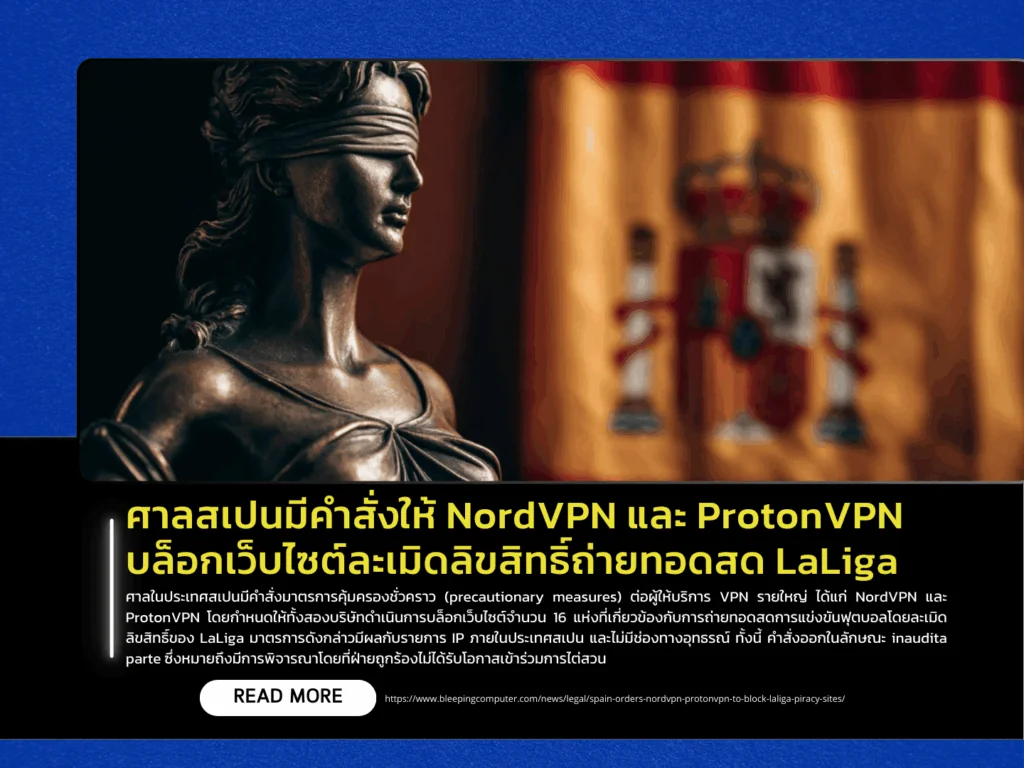
A Spanish court has issued precautionary measures against major VPN providers NordVPN and ProtonVPN, ordering both companies to block 16 websites involved in illegally streaming LaLiga football matches. The order applies to IP addresses within Spain and provides no opportunity for appeal. The ruling was issued inaudita parte, meaning it was granted without the defendants being heard in court. At the same time, LaLiga and its broadcasting partner Telefónica have been instructed to preserve sufficient digital evidence related to the unlawful distribution of protected content.
LaLiga, Spain’s top professional football league organizer, has consistently taken an aggressive stance against online piracy. In previous actions, it pursued legal measures against Cloudflare, alleging that the company facilitated illegal sports streaming. In this latest case, LaLiga and Telefónica argued that VPN providers fall under the European Union’s Digital Services Regulation (DSR) and therefore have an obligation to cooperate in preventing copyright infringement conducted through their infrastructure. The court order states that VPN systems are a “highly effective and easily accessible” means of disguising users’ geographic locations, enabling access to geographically restricted content. It also noted that some providers explicitly advertise their ability to bypass such restrictions.
ProtonVPN responded on social media, stating that it had not received formal notification of the proceedings and arguing that issuing a court order without notifying the affected party violates principles of due process. A spokesperson for NordVPN similarly confirmed that the company was not involved in any legal proceedings in Spain and maintained that domain blocking is not an effective solution to copyright infringement, as it does not address the root cause. Instead, NordVPN suggested targeting hosting providers, financial backers of illegal sites, and expanding access to legitimate content. The company also pointed out that such measures primarily affect paid VPN providers, while free VPN services-often more difficult to regulate-may continue to provide alternative routes for infringers to bypass restrictions.
