645/69 Monday, November 23, 2026
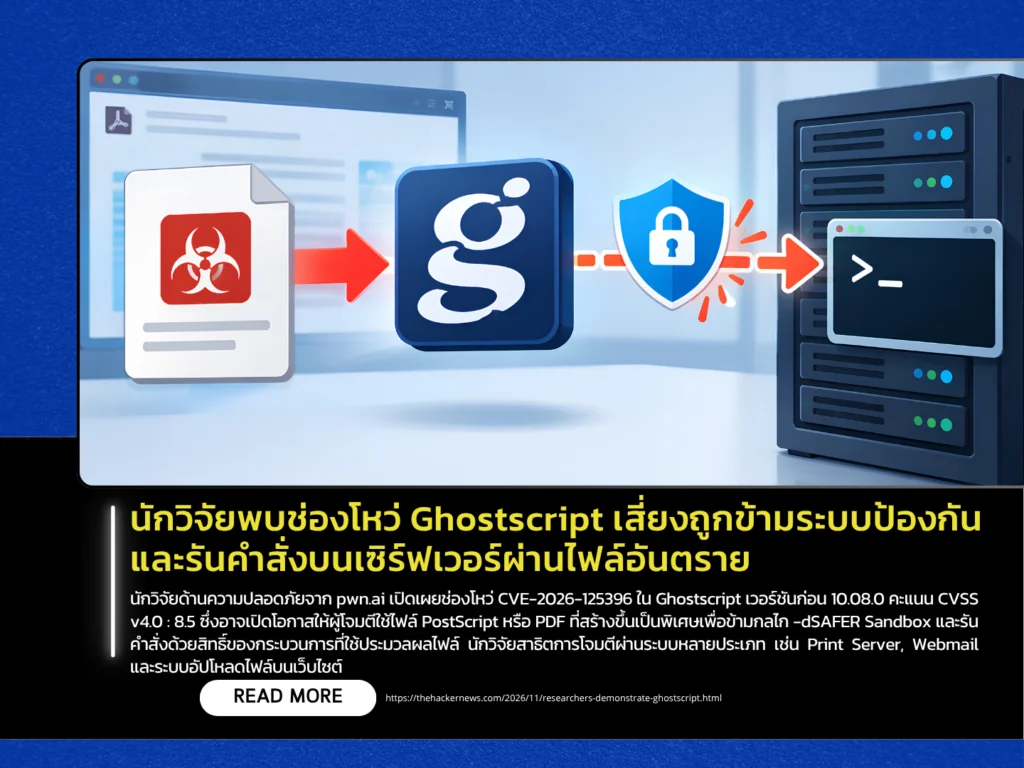
Security researchers from pwn.ai have disclosed CVE-2026-125396, a vulnerability affecting Ghostscript versions prior to 10.08.0, rated 8.5 under CVSS v4.0. The flaw could allow attackers to use specially crafted PostScript or PDF files to bypass the -dSAFER sandbox mechanism and execute commands with the privileges of the process handling the file. Researchers demonstrated exploitation across several types of systems, including print servers, webmail platforms, and website file-upload services, with some scenarios requiring no authentication. A Proof-of-Concept (PoC) demonstrating the vulnerability mechanism has been published, but there are currently no confirmed reports of exploitation in the wild.
The vulnerability is caused by a Use-after-free issue in Ghostscript’s Type 1 Font processing functionality, which can be abused to alter the state controlling -dSAFER and allow execution of commands that should normally be restricted by the sandbox. The risk is not limited to applications that invoke Ghostscript directly, because document and image-processing libraries such as ImageMagick, Pillow, and libvips may automatically pass files to Ghostscript for processing, even when the files use extensions such as .png, .jpg, or .pdf. Researchers confirmed potential attack paths in environments including Debian CUPS, Roundcube, and certain WordPress plugins, although exploitation conditions vary depending on system configuration.
Administrators should update Ghostscript to version 10.08.0 or later, or install vendor-provided packages confirmed to include the fix. Organizations should also check for separate Ghostscript installations inside containers or bundled applications, as updating the host package alone may not address every affected instance. If immediate patching is not possible, administrators should restrict file uploads from unauthorized users, limit the types of files processed by affected services, control access to print queues, and apply additional sandboxing measures such as AppArmor to reduce the impact of command execution. Debian and Ubuntu have already released fixed packages for supported systems.
Source: https://thehackernews.com/2026/11/researchers-demonstrate-ghostscript.html