623/69 Thursday, November 12, 2026
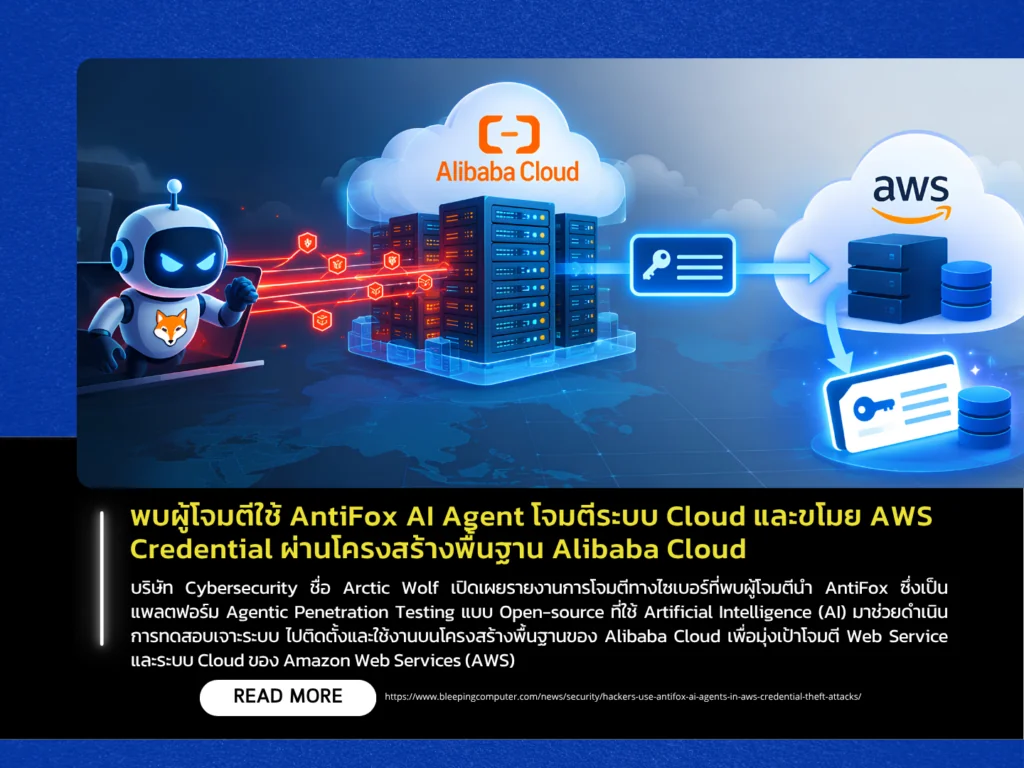
Cybersecurity company Arctic Wolf has disclosed a cyberattack campaign in which threat actors deployed AntiFox, an open-source Agentic Penetration Testing platform powered by Artificial Intelligence (AI), on Alibaba Cloud infrastructure to target internet-facing web services and Amazon Web Services (AWS) environments. AntiFox is derived from ARTEX version 0.1.1, features a Chinese-language interface, and supports AI agents that can automate penetration testing tasks such as identifying internet-exposed services and assessing target systems for vulnerabilities. Arctic Wolf observed AntiFox-related infrastructure being used for multiple malicious activities, including vulnerability exploitation, web shell deployment, credential validation, configuration reconnaissance, and the collection of sensitive information from AWS environments. The attackers were also observed using valid AWS identities, such as IAM users and EC2 roles, to submit AWS API requests under the permissions of legitimate accounts.
During the investigated incidents, attackers deployed ASPX web shells on internet-facing Internet Information Services (IIS) servers and used them to execute operating system commands, access application configuration files and database connection strings, and copy configuration files and logs into web-accessible directories. The attackers also used valid IAM credentials and EC2 roles to interact with AWS APIs and enumerate resources within cloud environments. In one incident, multiple AWS identities were used to issue hundreds of API requests within approximately 30 minutes. Although most requests were denied, the attackers were still able to access secrets used in production environments in some cases. In another incident, attackers used a valid AWS identity to read, copy, and delete objects stored in Amazon S3, highlighting the risk posed when stolen credentials allow attackers to access cloud resources through legitimate authentication mechanisms.
Arctic Wolf recommends that organizations investigate possible links between web shell activity on IIS servers and anomalous AWS access, particularly successful AWS API calls occurring among large numbers of denied requests. Organizations should also review application configurations for exposed credentials and sensitive information, revoke affected AWS sessions and access keys, and rotate credentials that may have been compromised. The findings follow earlier reports of ARTEX AI, another Agentic Penetration Testing platform developed in China, being used to support attacks against organizations and financial institutions in South Korea, as well as cyberespionage operations attributed to Vapor Panda targeting more than 200 organizations across 14 countries. AntiFox remains publicly available on GitHub and has since been updated to version 2.0. Although its developers prohibit the use of the tool for attacks against real-world systems or other illegal activities, no technical enforcement mechanism for those restrictions has been disclosed. The incidents demonstrate the growing risk of AI agents being used to automate parts of the attack process and expand access into organizational cloud environments.