628/69 Monday, November 16, 2026
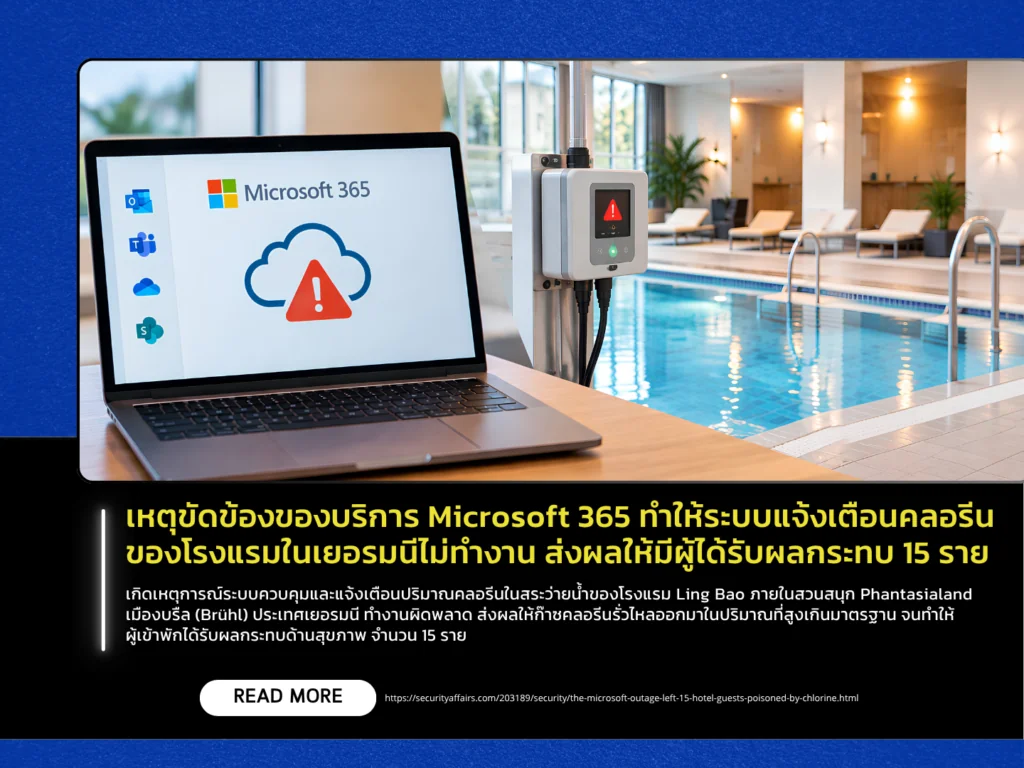
A malfunction in the chlorine control and monitoring system at Hotel Ling Bao, located within Phantasialand amusement park in Brühl, Germany, resulted in excessive chlorine gas exposure, affecting 15 hotel guests. The incident was reportedly linked to a global service disruption affecting Microsoft 365 cloud services and Outlook email between November 12 and 14, 2026. The outage prevented the hotel’s safety system, which was configured to send email notifications to staff when chlorine levels exceeded predefined safety thresholds, from delivering critical alerts. This incident highlights the risks associated with relying on a single cloud-based service for safety-critical alerting systems that directly affect human health and safety.
According to a report from the Brühl Fire Department (Feuerwehr Brühl), emergency services were alerted on Friday afternoon following a technical malfunction that caused excessive chlorine to be introduced into the hotel’s swimming pool, resulting in chlorine gas spreading throughout the pool area. More than 40 firefighters and emergency responders were deployed to the scene and spent approximately two hours containing the situation and assessing 15 affected individuals who experienced respiratory irritation. Of those affected, five were transported to hospitals for further medical treatment, including one person with moderate injuries and four with minor injuries. Following the incident, the hotel temporarily closed its swimming pool to conduct safety inspections before subsequently reopening it once the area was deemed safe.
This incident serves as an important case study for organizations and system administrators involved in designing automated systems or deploying Internet of Things (IoT) devices in safety-critical environments. Such systems should not rely exclusively on internet connectivity or a single cloud service to deliver essential safety alerts. System administrators should implement redundant alerting mechanisms that can operate independently of cloud services, such as local audible alarms or flashing warning lights. In addition, automatic fail-safe mechanisms should be configured to immediately shut down chemical dosing equipment when chemical concentrations exceed established safety limits, without requiring commands transmitted over a network. Organizations should also assess the risks associated with dependencies on third-party service providers and regularly conduct emergency response drills to ensure that personnel can respond effectively when primary systems become unavailable. These measures are essential to maintaining the continuous operation of safety systems, even during technical disruptions or cloud service outages.