633/69 Tuesday, November 17, 2026
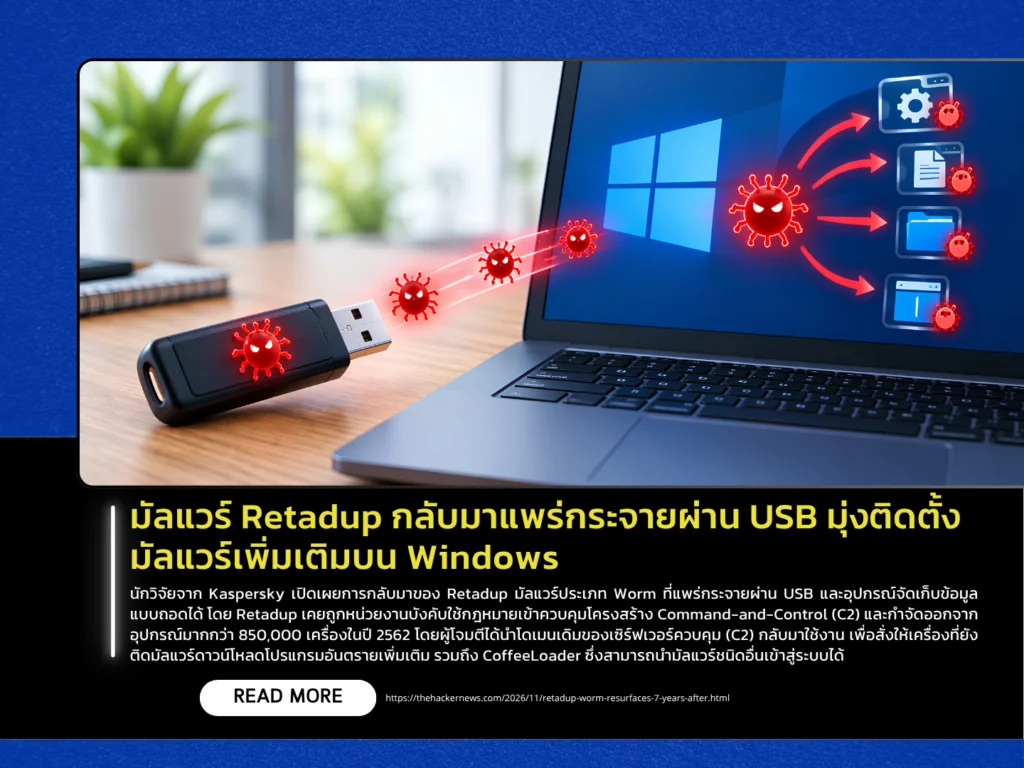
Researchers from Kaspersky have reported the resurgence of Retadup, a worm-type malware that spreads through USB drives and other removable storage devices. In 2019, law enforcement authorities took control of Retadup’s command-and-control (C2) infrastructure and removed the malware from more than 850,000 infected devices. However, attackers have reportedly reused the original C2 server domains to instruct systems that remain infected to download additional malicious software, including CoffeeLoader, a malware loader capable of delivering other types of malware. According to Kaspersky, during the first nine months of 2026, its security solutions blocked Retadup infection attempts on more than 15,000 devices across multiple countries.
Retadup spreads by copying hidden files and shortcut files (.lnk) onto USB drives or external storage devices. When an infected device is connected to another computer and a user opens the malicious shortcut, the worm installs itself on the system and communicates with its C2 server to receive instructions. In the latest campaign, Retadup has been used to download CoffeeLoader, which establishes persistence through Windows Registry Run keys and injects code into Windows processes before connecting to its C2 infrastructure to download additional payloads. Furthermore, newer versions of CoffeeLoader leverage the graphics processing unit (GPU) through OpenGL during the code decryption process, making malware analysis and detection more challenging.
Users and organizations are advised to scan USB drives and other removable storage devices with security software before opening any files, particularly when using older devices that have remained unused for extended periods. Additional recommended measures include disabling Autorun for removable media, enabling the display of file extensions, and avoiding the execution of unknown or suspicious shortcut files (.lnk), scripts, or applications. Operating systems and security software should also be kept up to date. Organizations should incorporate the Indicators of Compromise (IoCs) published by Kaspersky into their security monitoring and threat detection processes, as CoffeeLoader can download and execute additional malware, including infostealers and ransomware, on compromised systems.
Source https://thehackernews.com/2026/11/retadup-worm-resurfaces-7-years-after.html