643/69 Monday, November 23, 2026
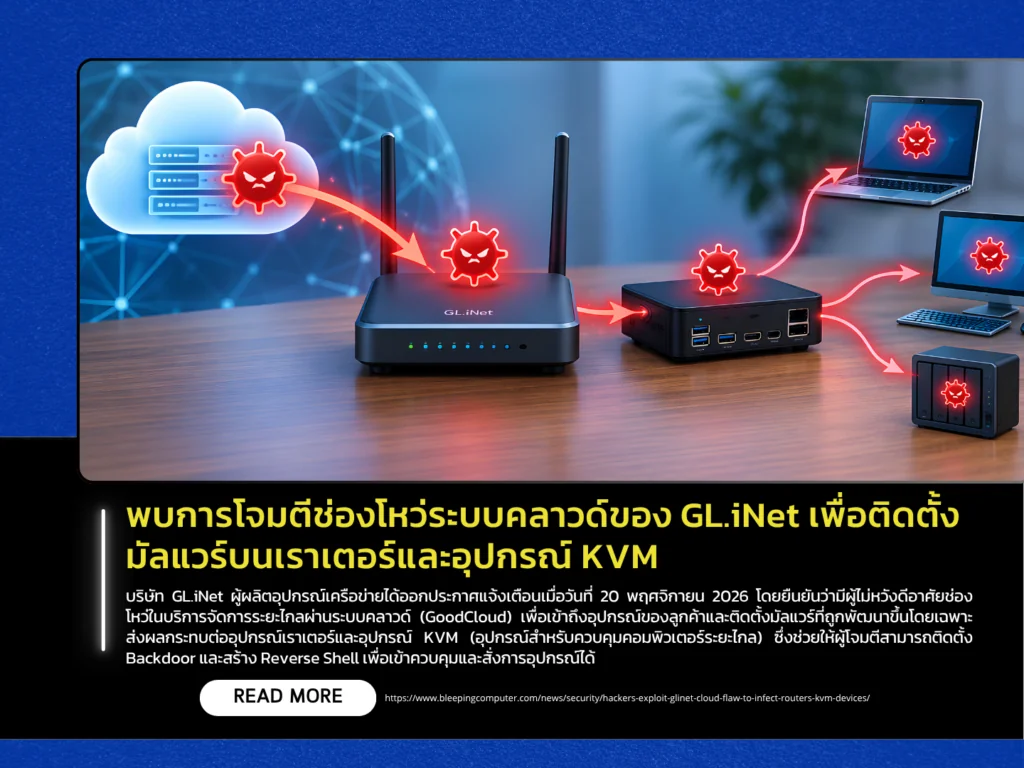
GL.iNet, a network equipment manufacturer, issued a security advisory on November 20, 2026, confirming that threat actors had exploited a vulnerability in its GoodCloud remote management service to access customer devices and deploy specially developed malware. The attacks affected routers and KVM devices used for remotely controlling computers, allowing the attackers to install backdoors and establish reverse shells for persistent command-and-control access. GL.iNet stated that it has blocked the attack path and fixed the vulnerability in its cloud infrastructure. However, these measures do not remove malware from devices that were already compromised. The company is also investigating whether computers connected to infected KVM devices may have been affected.
Technical analysis by security researchers and users found that the attackers used the Linux nc utility to establish outbound connections to 170.39.226[.]219 with Root privileges. A malicious script named ni.sh and payloads downloaded from 66.245.219[.]252 were also identified. The script could detect the affected device model and download additional malicious files named gl-helper and gb, while disguising activity under a process named crond -i /tmp/.log and modifying the netstat command to conceal network connections. Analysis of ni.sh also revealed Chinese-language comments describing logic for managing the rtty process by checking whether /etc/rtty_conf contained a connection to the attacker-controlled IP address 65.20.71[.]131. If GoodCloud later restored legitimate configuration values and interrupted the malicious connection, the script would restart the rtty service and then delete itself to reduce traces. On GL-MT2500 routers, researchers also found a Lua payload embedded by modifying the /etc/rc.common startup script associated with the urandom_seed service. The attackers copied /usr/bin/lua to /usr/bin/monitord and /bin/ulogd to /var/run/monitord.pid to execute malicious commands in the background before deleting files to conceal activity. Researchers from RemoteToHome Consulting preliminarily suggested that the vulnerability may involve insufficient input validation in GoodCloud’s AstroWarp/SD-WAN feature, allowing attacker-controlled data to be executed as shell commands with Root privileges, although GL.iNet has not confirmed this as the root cause.
To reduce risk and fully remediate affected systems, GL.iNet recommends that users and administrators immediately inspect their devices for suspicious activity, including the process crond -i /tmp/.log, or use the malware scanning and removal tool developed by the user community and referenced through the company’s official support page. Users should also update device firmware to the latest security release even if no signs of compromise are detected. For KVM devices, GL.iNet recommends version 1.10.3 or later for RM10, RM1, RM1V2, RM1PE, and RM4PE; version 1.10.3 beta or later for RM10RC; and version 1.8.7 or later for RMQ1.